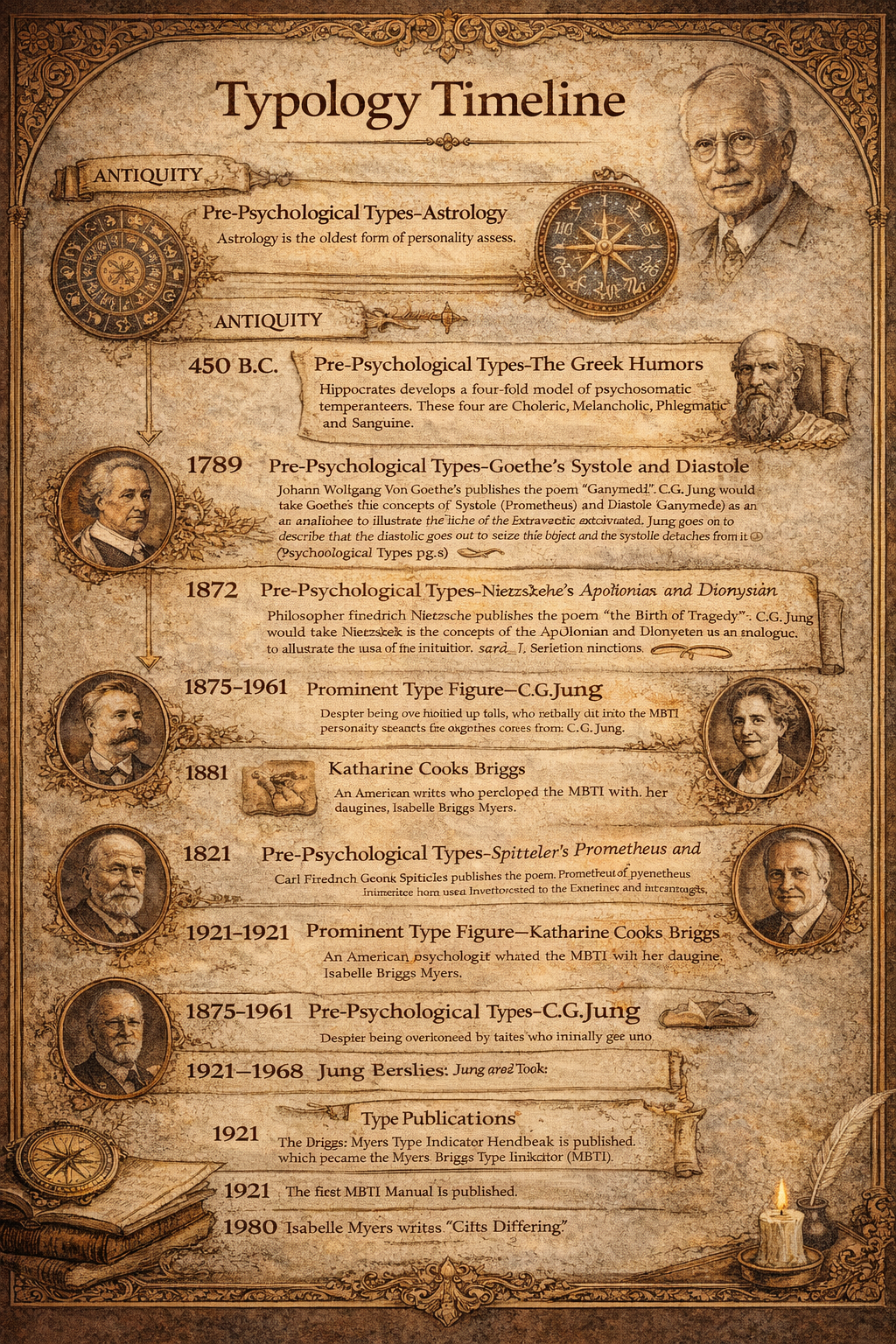
- ANTIQUITY
Pre-Psychological Types-Astrology
Astrology is the oldest form of personality assessments.
- ANTIQUITY
Pre-Psychological Types-Ayurveda
The Ancient Indian system of Holsitic Medicine uses a three-fold model of psychosomatic temperaments. These four are Kapha (Endomorph), Pitta (Mesomorph) and Vata (Ectomorph).
- 450 B.C.
Pre-Psychological Types-The Greek Humors
Hippocrates develops a four-fold model of psychosomatic temperaments. These four are Choleric, Melancholic, Phlegmatic and Sanguine.
- 1789
Pre-Psychological Types-Goethe’s Systole and Diastole
Johan Wolfgang von Goethe’s publishes the poem “Ganyemed,” C.G. Jung would take Goethe’s the concepts of Systole (Prometheus) and Diastole (Ganymede) as an analogue to illustrate the idea of the Introverted and Extraverted Attitudes. Jung goes on to describe that the diastolic goes out to seize the object and the systolic detaches from it (psychological types pg.5)
- 1872
Pre-Psychological Types-Nietzsche’s Apollonian and Dionysian
Philosopher Friedrich Nietzsche publishes the poem “The Birth of Tragedy.” C.G. Jung would take Nietzsche’s the concepts of the Apollonian and Dionysian as an analogue to illustrate the idea of the Intuitive and Sensation functions.
- 1875-1961
Prominent Type Figure-C.G. Jung
Despite being overlooked by folks who initially get into the MBTI personality research, its originator comes from C.G. Jung.
- 1875-1968
Prominent Type Figure-Katharine Cooks Briggs
An American writer who developed the MBTI with her daughter, Isabelle Briggs Myers.
- 1881
Pre-Psychological Types-Spitteler’s Prometheus and Epimetheus
Carl Friedrich Georg Spitteler publishes the poem “Prometheus und Epimetheus,” C.G. Jung would take Spitteler’s the concepts of Prometheus and Epimetheus as an analogue to illustrate the idea of the Introverted and Extraverted Attitudes. Jung goes on to correlate the Promethean with Introvert and forethought, and the Epimethean with the Extravert and afterthought.
- 1897-1980
Prominent Type Figure-Isabelle Briggs Myers
Co-Developer of the MBTI with her mother Katharine.
- 1921
Type Publications
Jung Publishes “Psychological Types, or The Psychology of Individuation,” later to become volume 6 of the Collected Works.
- 1921-2013
Prominent Type Figure-David Keirsey
An American psychologist who focused on Temperament theory in Personality.
- 1923
Type Event
Katharine Briggs reads Jung’s “Psychological Types,” and begins the pre-work for the MBTI with her Daughter Isabelle.
- 1928
Pre-Interaction Styles
John Geier develops the DiSC model.
- 1939-PRESENT
Prominent Type Figure-John Beebe
Jungian Analyst John Beebe, known for his eight-function, eight archetypal model of typology. John integrates elements of Jungian Psychology and the MBTI together into a cohesive model. He focuses on the shadow aspects of the personality and typology.
- 1939-PRESENT
Prominent Type Figure-Linda Berens
Linda Berens has designed new and integrated of the elements of the old personality models into an understandable way. She brings in Keirsey, Jung, Beebe and others. She is known for her Interaction Styles, Essential Motivators, Cognitive Dynamics and Intentional Styles Models.
- 1939-PRESENT
Prominent Type Figure-Dario Nardi
Known for his research on the Neuroscience of Personality, Dario is on the leading edge of Personality Type research. He has partnered with Linda Berens over the years to write a few books as well as his own. Dario has an interest in Jung and specially Jung on Yoga.
- 1944
Type Publications
The Briggs Myers Type Indicator Handbook is published which became the Myers-Briggs-Type-Indicator (MBTI).
- 1962
Type Publications
The first MBTI Manual is published.
- 1980
Type Publications
Isabelle Myers writes “Gifts Differing.”
- 2016
Type Publications
John Beebe publishes his book on his Archetypal Model on Psychological Type called “Energies and Patterns in Psychological Type: The Reservoir of Consciousness.”