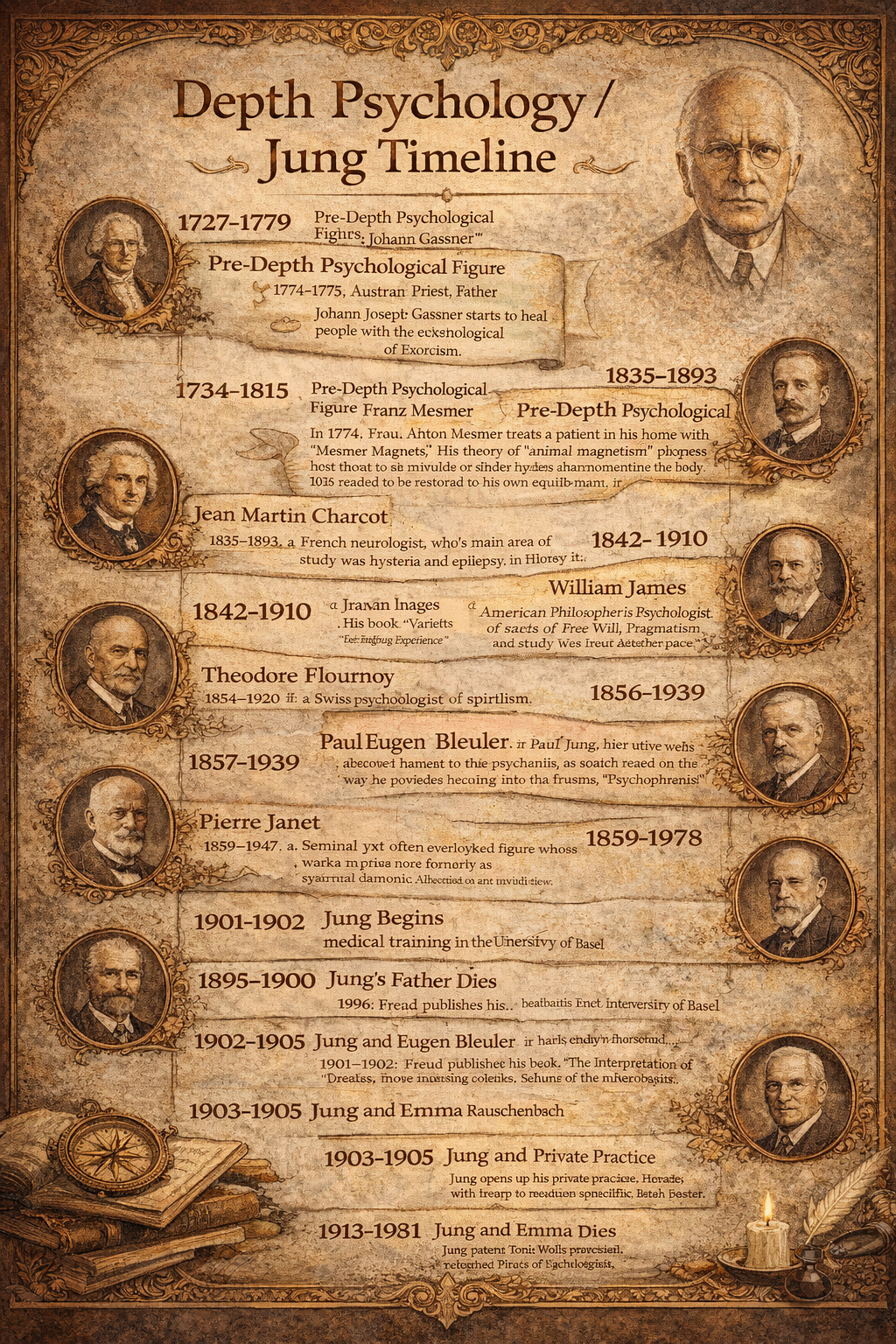
 1727-1779
Pre-Depth Psychological Figure Johann Gassner
In 1774-1775, Austrian Priest, Father Johann Joseph Gassner starts to heal people with the soteriological practice of Exorcism.
- 1734-1815
Pre-Depth Psychological Figure Franz Mesmer
In 1774, Franz Anton Mesmer treats a patient in his home with “Mesmer Magnets.” His theory of “animal magnetism,” proposes that there is an invisible or subtle fluidic substance in the body that needed to be restored to its own equilibrium. This has obvious parallels to the Indian concept of Prana in the Nadis or the Chinese “Qi” that flows through the subtle meridians. It relates to the Jungian concept of “Mana” or power/libido that is inherent in objects. The techniques of Mesmerism would evolve later into forms of hypnotism in the Nancy School. The term “Mesmerized,” comes from the experiments of Mesmer.
- 1835-1893
Pre-Depth Psychological Figure Jean Martin Charcot
Jean-Martin Charcot (1835-1893), a French neurologist, who’s main area of study was hysteria and epilepsy. In his school, he worked to establish a scientific explanation of what were known formerly as spiritual/demonic diseases under the umbrella term “Hysteria.” He had a strong influence on Freud and Janet therefore C.G. Jung by alluding to “fixed” ideas in the unconscious. Janet would pick this idea up first and then later Jung would refine it in his concept of “psychological complexes.”
- 1842-1910
Pre-Depth Psychological Figure William James
William James is an American Philosopher and Psychologist. His book “Varieties of Religious Experience” and ideas about Free Will, Pragmatism, and Empiricism would prove to be highly influential on Jung and his work.
- 1854-1920
Pre-Depth Psychological Figure Theodore Flournoy
Theodore Flournoy, a Swiss psychologist and author on parapsychology and spiritism. His book, from India to the Planet Mars would indirectly influence Jung.
- 1856-1939
Pre-Depth Psychological Figure Signmund Freud
Sigmund Freud (1856-19390, was known as one of the “Fathers” of modern psychology. He started his career as a “pre-psychoanalytic” neurologist before establishing his new school of psychology called “Psychoanalysis” and the last precursor to Depth Psychology. His primary influences were Charcot and Breuer, who used the methods of hypnosis and the catharsis respectively. He focused on the pre-sexual trauma in Hysterics. Several ideas and terms would later be adopted and/or re-purposed by Jung. Ideas like that of transference (Mesmer’s rapport principle), conscious, pre-conscious, and the unconscious would be expanded upon by Jung. much a product of the thinking of his time, Freud’s aim was to develop a “scientific psychology,” though his theories would eventually not pass the acid test. His naming of the Oedipus complex and book on the Interpretation of Dreams would have a lasting impact on C.G. Jung and his theories.
- 1857-1939
Pre-Depth Psychological Figure Paul Eugen Bleuler
Eugen Bleuler was a Swiss Psychiatrist, a tutor of Jung, who devoted himself to the area of psychosis. He is known for coining the term “schizophrenia.”
- 1859-1947
Pre-Depth Psychological Figure Pierre Janet
Pierre Janet (1859-1947), is a seminal yet often overlooked figure whose works provided the seeds for the theories of Freud, Adler, and Jung. Janet began his studies at the Salpêtrière with Charcot and used Charcot to access clinical material for his research on psychology. Jung would adopt and re-purpose many of Janet’s ideas, including “subconscious fixed ideas” and psychological automatisms,” which become Jung’s “Psychological Complex,” and the autonomy of the complexes. Janet’s Fonction du Reel, or “Attention to Present Life,” would also serve as a baseline for Jung’s concept of the sensation function.
- 1860-1880
Pre-Depth Psychological Institution: The Nancy School
The Nancy school was a Psychotherapeutic institution that used the techniques of magnetism and hypnotism. Doctor Auguste Ambroise Liebeault (1823-1904) practiced hypnosis on his patients and put them into “hypnotic” states of sleep. Hypnosis, although discarded by the future Depth Psychologists, would later contribute and open the door to Westerners to the idea of an Unconscious and something “behind” consciousness.
- 1870-1937
Depth Psychological Figure Alfred Adler
Alfred Adler (1870-1937), aimed to synthesize socialism and medicine. He focused on “individual psychology” and the unique individuality of the person. His theory of organ inferiority claimed that it was a cause of assertion and aggression, brought upon by social factors. In contrast to Freud’s “pleasure” principle that Jung would correlate to extraversion, the feelings of inferiority in an individual resulted in a “power” drive or principle that Jung would adopt as an analogue for describing the “introvert” in his theory of Psychological Types.
- 1875
C.G. Jung Born
C.G. Jung is born in Kesswil, Switzerland
- 1895-1900
Jung Begins Medical Training At The University Of Basel
- 1896
Jung’s Father Dies
Jung’s Father dies.
- 1899
Freud Publication
Freud publishes his book “The Interpretation of Dreams,” where his “Pleasure Principle” is elucidated as he discusses his findings on the unconscious wish fulfillment and the underpinnings of the latent dream content. Though this excited Jung and would plunge him into his own research and theory of dreams, he ultimately would reject Freud’s sexual interpretations as the only interpretation.
- 1900
Jung And Eugen Bleuler
Jung begins psychiatric career at the Burgholzli Mental Hospital under the guidance of Professor Eugen Bleuler.
- 1901-1902
Jung And Janet
Jung spends a semester with Pierre Janet in Paris to study theoretical psychopathology.
- 1902-1905
Jung Publications
The book “Psychiatric Studies” published. Became Volume 1 of the Collected Works.
- 1903
Jung And Emma
Jung marries Emma Rauschenbach
- 1903-1905
Jung And The Word Association
Jung begins his research on the word association method.
- 1903
Jung Publications
Doctoral dissertation “On the Psychology and Pathology of So-Called Occult Phenomena.”
- 1904
Jung And Child/Sabina
Jung has his first child. Also meets Sabina Spielrein.
- 1904-1907
Jung Publications
Studies in Word Association, Experimental Researches which became volume 2 of the Collected Works.
- 1905-1909
Jung And The University Of Zurich
At the University of Zurich, Jung is a senior staff physician and lecturer.
- 1906
Jung And Freud
Jung begins to work with Sigmund Freud. Has his second child.
- 1907
Jung Publications
Publishes “The Psychogenesis of Mental Disease,” originally named “The Psychology of Dementia Praecox” (Schizophrenia). Became volume 3 of the Collected Works.
- 1908
Jung And Child
Jung’s third child is born.
- 1909
Jung And Private Practice
Jung opens up his private practice. Travels with Freud to the U.S. and receives an Honorary Doctor of Laws degree from Clark University.
- 1910
Jung And IPA/Toni Wolff
Jung meets Toni Wolff. His fourth child is born. Becomes president of the International Psychoanalytic Association.
- 1912
Jung And Fordham University
Jung gives a series of lectures in New York at Fordham University and receives another honorary doctorate that acknowledges his research on the Word Association Method.
- 1912
Jung Publications
Publishes “Symbols of Transformation.” Originally named as “Psychology of the Unconscious.” Became volume 5 of the Collected Works. The trigger point for the break with Freud.
- 1913
Freud Publication
Freud publishes his anthropological work stemming from his Oedipus Complex Theory. It is comprised of four essays: “The horror of Incest,” “Taboo and Emotional Ambivalence,” “Animism, Magic and the Omnipotence of Thoughts,” and the “The Return of Totemism in Childhood.” This was released right around the time Jung released his “Symbols of Transformation,” and further wedged the two colleagues further apart from each other.
- 1913
Jung And Freud
Jung breaks with Freud. Renames his psychology “Analytical Psychology.” Jung starts to work on the black books.
- 1913-1981
Depth Psychological Figure Heinz Kohut
Heinz Kohut (1913-1981), born in 1913, Kohut is a psychoanalyst and object relations theorist who deviated from Freud and worked to develop his “Self-psychology.” This is different from Jung’s “Self.” It deals with Narcissistic wounding through the idealization transferences from “Self-Objects.” The Yogic correlation to Kohut’s psychology would be to the Heart Chakra.
- 1914
Jung And IPA
Jung resigns as president of the International Psychoanalytic Association. His fifth child is born.
- 1914
Jung And The Psychological Club Zurich
Jung founded the Psychology Club Zurich. He starts to use the terms “Personal & Collective Unconscious, Individuation, Anima/Animus, & Persona.” He begins his studies on Gnosticism. Starts to paint Mandalas and develop the technique of Active Imagination.
- 1917
Jung Publications
Publishes “Collected Papers on Analytical Psychology.” Which would is found in “Freud and Psychoanalysis,” volume 4 of the Collected Works. Also, the first edition of “Two Essays on Analytical Psychology” came out, later becoming volume 7 of the Collected Works.
- 1918-1919
Jung And Psychological Terms
Jung first uses the term Archetype in his paper on the “Instinct & the Unconscious.”
- 1920
Jung And Africa
Jung travels to Algeria and Tunisia.
- 1921
Jung Publications
Publishes “Psychological Types, or The Psychology of Individuation,” later to become volume 6 of the Collected Works.
- 1923
Jung’s Mother Dies
Jung’s Mother dies. He starts to build his Bollingen tower on Lake Zurich.
- 1925
Jung Lectures
Jung gives a Seminar on Analytical Psychology.
- 1925-1926
Jung And Africa
Jung travels to Africa again to the countries of Kenya, Uganda, and the Nile river.
- 1928
Jung Publications
Contributions to Analytical Psychology.
- 1928
Jung And Alchemy
Jung begins his study of alchemy after his colleague Richard Wilhelm sends him a copy of the Chinese text, “The Secret of the Golden Flower.” Jung starts to reference the concept of Synchronicity.
- 1929
Jung And Psychological Terms
Jung’s official use of the term Synchronicity.
- 1930
Jung And Pauli
Jung meets Noble Prize winning Physicist Wolfgang Pauli.
- 1930-1934
Jung Lectures
Called the “Visions Seminars,” Jung lectures on the visions of a woman named Christiana Morgan.
- 1932
Jung Lectures
Jung lectures on Kundalini Yoga at the Psychological Club in Zurich. Later notes compiled and published by Sonu Shamdasani.
- 1933
Jung And Von Franz
Jung meets future colleague Marie-Louise von Franz. Begins lecturing at the ETH (Eidgenössische Technische Hochschule). Presents “A Study in the Process of Individuation” as his first lecture at Eranos. Travels to Egypt and Palestine.
- 1933
Jung Publications
Modern Man in Search of a Soul
- 1934-1939
Jung Lectures
The Zarathustra Seminars.
- 1934-1954
Jung Publications
Publishes “The Archetypes and the Collective Unconscious.” Later would become volume 9, part 1 of the Collected Works.
- 1935
Jung And ETH
Becomes titular professor at the ETH. Presents his Tavistock Lectures at IMP (Institute of Medical Psychology) in London.
- 1936-1940
Jung Lectures
Jung is presenting at the Swiss Federal Institute of Technology in Zurich and gives a four-year lecture series on Children’s Dreams.
- 1936
Jung Honorary Doctorate
Jung receives an honorary Doctorate of Science from Harvard University.
- 1937
Jung And University
Gives the Terry Lectures on Psychology and Religion at Yale University.
- 1938
Jung And India
Jung travels to India. Receives three honorary doctoral degrees from the University of Calcutta, Benares and the Islamic University of Allahabad. Also received an honorary Doctor of Sciences from Oxford University.
- 1938-1940
Jung And ETH
Jung presents lectures at ETH on the Psychology of Yoga and Meditation
- 1938
Jung Publications
“Psychology and Religion: West and East.” Would become volume 11 of the Collected Works.
- 1942
Jung And ETH
Jung steps down as professor at the ETH.
- 1944
Jung Publications
“Psychology and Alchemy.” Later would become volume 12 of the Collected Works.
- 1944
Jung Illness
Jung has his first heart attack.
- 1947
Jung Publications
“On the Nature of the Psyche.” Later would be found in volume 8 of the Collected Works.
- 1948
Jung Institutes
C.G. Jung Institute Zurich established.
- 1949
Jung Publications
Writes the Forward to Wilhelm’s text on the I-Ching.
- 1951
Jung Publications
Publishes “Aion: Researches into the Phenomenology of the Self.” Later would become volume 9, part 2 of the Collected Works.
- 1951
Jung Lectures
Presents paper”On Synchronicity” at Eranos.
- 1952
Jung Publications
Publishes “Synchronicity: An Acausal Connecting Principle.”
- 1952
Jung Publications
Publishes “Answer to Job.” Later to be found in volume 11 of the Collected Works.
- 1952
Jung Illness
Jung has his second heart attack.
- 1955
Jung And Emma
Jung’s wife Emma dies.
- 1955
Jung Degrees
Receives an honorary Doctorate in Natural Sciences from the ETH.
- 1956
Jung Publications
“Mysterium Coniunctionis: An Inquiry into the Separation and Synthesis of Psychic Opposites in Alchemy.” It would become Jung’s last intensive book, which he wrote, and volume 14 of the Collected Works.
- 1959
Jung Publications
Publishes “Flying Sauces: A Modern Myth of Things Seen in the Skies.”
- 1961
Jung Death
Jung dies at age 85.